How Social Media Generates Real Sales: From Followers to Paying Customers
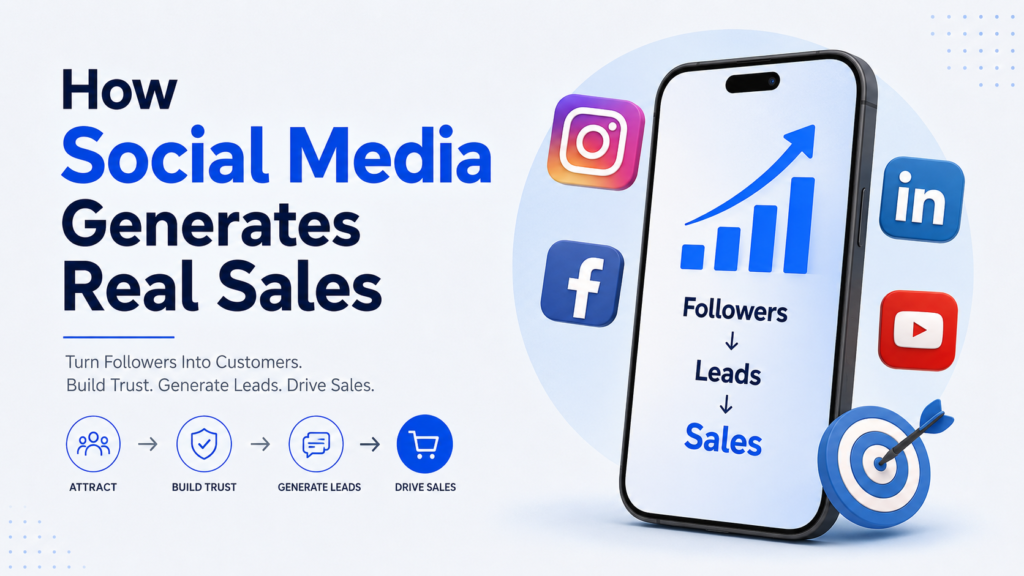
Social media is often treated as a place to build followers, likes, comments, and brand awareness. But for businesses, its real value goes much deeper.
When used strategically, social media can help a business attract the right audience, build trust, generate leads, nurture prospects, and drive actual sales.
The important question isn’t, “How many people saw my post?”
It is:
“How many of those people moved closer to becoming customers?”
Moreover For marketers and business owners, understanding this difference can completely change how social media is approached.
Social Media Is More Than an Awareness Channel
A common misconception is that social media only helps people discover a brand.
Discovery is certainly part of the journey, but it doesn’t have to be the end.
Consider a local interior design studio. Eventually Someone may first discover the studio through an Instagram Reel showing a beautifully designed living room. They follow the account, watch a few project videos, read client testimonials, and eventually send a WhatsApp message asking about their services.
For example This journey could look like this:
Instagram Reel → Profile → Portfolio → Trust → Inquiry → Consultation → Sale
In addition The social media post didn’t directly “sell” the service.
It started a customer journey that eventually generated revenue.
That’s where effective social media marketing becomes much more valuable.
1. Social Media Attracts the Right Customers
The first step toward generating sales is reaching people who actually have a reason to buy.
Platforms such as Instagram, Facebook, LinkedIn, and YouTube allow businesses to target audiences based on interests, behaviour, demographics, location, and other signals.
For example, a gym in Vadodara doesn’t need thousands of random followers.
moreover It needs people in Vadodara who are interested in fitness and are likely to purchase a membership.
Instead of focusing on:
“How do I get more followers?”
the better question is:
“How do I get the right potential customers to notice me?”
Also relevant reach creates a much stronger foundation for sales.
2. Content Builds Trust Before the Sales Conversation
People rarely buy from businesses they don’t trust.
Social media gives businesses an opportunity to demonstrate expertise before asking someone to make a purchase.
For example, a digital marketing agency could publish:
- Website mistakes that cost businesses leads
- Real campaign breakdowns
- Before-and-after marketing results
- Client case studies
- Practical advertising tips
- Common mistakes business owners should avoid
Eventually this type of content answers an important question in the customer’s mind:
“Can these people actually solve my problem?”
When the answer becomes “yes,” the sales conversation becomes much easier.
3. Social Proof Removes Buying Hesitation
One of the biggest barriers to purchasing is uncertainty.
In Addition Customers want to know:
“Has this worked for someone like me?”
moreover, Social media can provide that reassurance through testimonials, reviews, case studies, user-generated content, project showcases, and customer results.
For Example Imagine two businesses offering the same service.
Here Business A simply says:
“We provide high-quality digital marketing services.”
Then here Business B shows:
“How we generated 250+ leads using Meta Ads.”
Then think, Which one gives a potential customer more confidence?
The second business provides evidence.
Moreover, That evidence can shorten the distance between interest and purchase.
4. Social Media Can Generate Direct Leads
Social media doesn’t always need to send customers to a website.
Eventually Businesses can generate leads directly through:
- Instagram DMs
- Lead forms
- Facebook Messenger
- Booking links
- Consultation forms
For example, a real estate company could publish a Reel showcasing a new property and include a simple CTA:
“DM ‘PRICE’ for the complete property details.”
Then someone interested sends a message.
That person can then be qualified, contacted by the sales team, and moved toward a site visit.
The post generated more than engagement.
It generated a sales opportunity.
5. Paid Social Advertising Can Accelerate Sales
Organic content builds trust over time, but paid advertising can put an offer in front of a highly relevant audience much faster.
Suppose an e-commerce brand sells skincare products.
Instead of simply promoting the product to everyone, the brand could run different campaigns for:
Cold audience:
Introduce the product and explain the problem it solves.
Warm audience:
Retarget people who watched videos, visited the website, or interacted with Instagram.
Hot audience:
Show an offer to people who added products to their cart but didn’t purchase.
This creates a simple customer journey:
Discover → Consider → Revisit → Purchase
The objective isn’t simply to get cheaper clicks.
It is to build a system where advertising contributes to measurable revenue.
6. Retargeting Brings Interested Customers Back
Not everyone buys the first time they see your business.
Someone might visit your website, check your pricing, and leave.
That doesn’t necessarily mean they aren’t interested.
They may simply need more information or time.
Retargeting allows businesses to reconnect with people who have already shown interest.
For example:
A customer visits an online store and views a pair of shoes.
They don’t purchase.
Later, they see an advertisement reminding them about the product or showing a customer review.
That second interaction may be what finally convinces them to buy.
This is why successful social media marketing doesn’t focus only on finding new people.
It also follows up with people who are already interested.
7. Strong Calls-to-Action Turn Attention Into Action
Even excellent content can fail to generate sales if customers don’t know what to do next.
Moreover, every important piece of content should have a logical next step.
Instead of:
“Follow us for more tips.”
a business might use:
“DM us ‘AUDIT’ for a free marketing audit.”
Or:
“Book a consultation through the link in our bio.”
Or:
“Message us to check today’s availability.”
The CTA should match the customer’s stage and their buying journey also.
Someone discovering your brand for the first time may need educational content.
moreover, someone who already understands the problem may be ready for a consultation or product offer.
Measure Sales, Not Just Likes
One of the biggest mistakes businesses make is judging social media success purely through engagement.
Likes and followers can be useful indicators, but they don’t tell the complete story.
Businesses should also track metrics such as:
- Leads generated
- Cost per lead
- Website conversions
- WhatsApp inquiries
- Bookings
- Sales
- Customer acquisition cost
- Return on ad spend
- Revenue generated
For example, a post with 20,000 views and zero inquiries may be less valuable than a post with 3,000 views that generates 15 qualified leads.
Finally “Reach creates opportunity. Strategy creates conversion”.
The Real Social Media Sales Funnel
A profitable social media strategy usually connects several stages:
Attention → Interest → Trust → Consideration → Action → Follow-up → Sale
Content attracts attention.
Educational posts build interest.
Case studies and testimonials build trust.
Offers create consideration.
Calls-to-action generate action.
Retargeting and follow-up recover missed opportunities.
Sales processes turn qualified leads into customers.
This is why social media should not be treated as a collection of random posts.
moreover, It should work as part of a larger marketing and sales system.
Final Thoughts
Social media can absolutely generate real sales—but posting consistently isn’t enough.
Businesses need the right audience, useful content, compelling offers, strong calls-to-action, effective follow-up, and proper measurement.
The goal isn’t to create content that simply gets people to stop scrolling.
The goal is to create content that moves the right people one step closer to buying.
At Studio Digimarck, we believe social media works best when it is connected to a bigger growth strategy—not treated as a vanity-metrics game.
Because ultimately, the most important question isn’t:
“How many people engaged with your content?”
It’s:
“How did your social media activity contribute to business growth?”

Leave a Reply